Posts tagged cultural worlds
Nate
:
Non-white medical students are more likely to embrace orthodox medicine and reject therapies traditionally associated with their cultures. That is one finding from an international study that measures the attitudes of medical students toward complementary and alternative medicine (CAM). While seemingly counter-intuitive, white students view CAM more favorably than their non-white counterparts, the study authors say….
n the first study, U.S. medical students wanted more courses about CAM than students in Hong Kong, for example. (The Hong Kong school was not included in the 2nd survey of fourth year students.) The second study continued to support that trend with the least interest in CAM measured in Asian and black students.


Nate
:
Religion | Now churches are getting into market research, hiring consultants as “mystery worshippers” to show up on Sunday and evaluate “everything from the cleanliness of the bathrooms to the strength of the sermon.” It used to be that one mysterious presence to keep an eye on things was enough. [Wall Street Journal]
 Noise pollution, 1930s-style
Nate
:A police amphibian airplane trailed a tri-motored ship from which advertising matter was being broadcast through a loud-speaker for almost two hours yesterday afternoon.
The dead among us
Nate
:That is why the Great Plague of 1665 has been largely understood as a London phenomenon. The sites of old plague pits are now pointed out with understandable pride. Richard Barnett reveals that the escalator at Camden Town Underground station passes through a vast grave for plague victims, and that a “massive plague pit” is responsible for the low ceiling of the basement of Harvey Nichols. It would be fair to say that he takes a certain, rather morbid, pleasure in compiling this Baedeker of disease and suffering. But why not? This is London’s real heritage. Together with this volume are a glossary and six maps, so that the reader can make his or her way down the various roads to oblivion. If you wish to follow the course of tropical disease as it ate its way to the heart of the metropolis, you can do so; you can follow the route of the plague, or the life of an 18th-century medical student. All human life, and human death, is here.
 Mayan playing cards

Nate
: Frickin’ awesome!
Nate
:
Nonetheless, a few months ago I became a ”Young Fellow” at the Frick museum ($500 per year; “all but $340 is tax deductible”). I’ll admit I felt slightly ambivalent about it. As much as I enjoy going to museums and sincerely believe they help to make the world a better place, giving to them is not quite on a par with giving to a cancer hospital. Cultural institutions are a luxury in our society. Surely there are more pressing concerns.
My agenda was to join an organisation that promotes community. In my research, I found that cultural institutions have a monopoly on providing frequent, affordable events that also, frankly, seem fun. My hard-earned, limited income could instead go toward feeding starving children in Africa, which is surely a worthier cause than maintaining the art collection of an old mansion on Fifth Avenue. But starving children do not provide fun parties. Point: museum.
Modelling Snow White
In addition to making Snow White fashionable, Grim also “began to absorb more and more of the actual live model” into his drawings, writes Johnson, who happened to be a 14-year-old girl named Marge Belcher, who was 16 when they finished filming. Take a look at that face—it’s not exactly the childlike countenance Disney princesses have these days, is it?
Look at Snow White on the Disney Princess official website, Sure she’s been hipped up a bit to fit into modern times and, apparently, that included her waistline—it’s smaller than Barbie’s! (Go download Snow White’s wallpaper and then ask yourself, are the dwarfs even feeding her?)

Nate
:Nate
:As part of the Japanese census, people were asked to keep a record of what they were doing in 15 minute intervals. The data was publicly released and Jonathan Soma took it and graphed the results so that you can see what many Japanese are up to during the course of a normal day.
“Sports: Women like swimming, but men eschew the water for productive sports, which is the most important Japanese invention.
Early to bed and early to rise… and early to bed: People start waking up at 5 AM, but are taking naps by 7:30 AM.”
Fascinating.
Nate
:Buddhist-Christian dialogue seems awfully passé to me in an era when positive dialogue seems all too scarce among Muslims, Christians, and Jews, on the one hand, and between crusading atheists and theists of all stripes, on the other. But I do appreciate Thomas Merton’s appreciation of the hermit life—the need to get away from it all—even though he may have been one of the most outspoken Trappists who ever lived (as my father is one of the more talkative Quakers I’ve ever met). The editor of Buddhist-Christian Studies, however, thinks Merton ignored one vital class of hermits (p. viii, n. 5):
“Merton’s model of the hermit life does not exhaust the phenomenon within Western Christianity. Historically speaking, the hermit life was embraced by far more people than the limited number of professed monks whose spiritual growth had taken them beyond the life of the coenobium. For example, hermit shrine keepers were numerous throughout Christian cultures for centuries; most of these were simple laity without whom many pilgrimage sites would simply not have existed, and their identity has not yet found a modern voice. The massively popular pilgrimage churches of traditional Catholicism had at their heart the hermit-sacristan who tended the lamps and swept the floors. The professed hermit monk, the monastic hermit order, and the shrine hermit all found expression in the legal and the architectural boundaries of medieval and early modern societies.”
Perhaps lay bloggers, photographers, and Wikipedists can be considered the hermit-sacristans of this information age, quietly tending our quirky little shrines that attract pilgrims who seek to escape the self-referential obsessions of the cloistered academies and the hourly tolling of alarm bells from the cathedrals of the major media.


Nate
:Leaving Las Vegas
Nate
:Also noteworthy, according to Wray, is the finding that if you live in Las Vegas, but travel away from home, your risk for suicide decreases. “So, one conclusion we might draw from this fact is that something about the place is toxic or ‘suicidogenic,’ and that there is something about reduced exposure to Las Vegas that is beneficial,” said Wray.
Cheaper than a bottle of wine
Nate
:
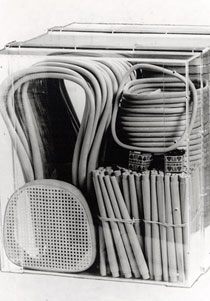
It consists of six pieces of wood - two circles, two sticks and a couple of arches - held together by 10 screws and two nuts. Together they make the wooden chair known as Thonet Model No.14, which although no one has ever actually done the math, is thought to have seated more people than any other chair in history.
The No.14 was the result of years of technical experiments by its inventor, the 19th-century German-born cabinetmaker Michael Thonet. His ambition was characteristically bold. Thonet wanted to produce the first mass-manufactured chair, which would be sold at an affordable price (three florins, slightly less than a bottle of wine).

Nate
:
Nate
:Golden Gai, Tokyo

Nate
:In tune with the times
Nate
:Equal temperament, Duffin says, suited the conditions of the 20th century. It jibed with capitalism because it enabled manufacturers to mass produce pianos, which all now had the same tuning, and which, since the piano was the chosen instrument of the middle class, determined the tuning of other instruments. It also was “democratic,” a politically correct system in which all keys were created equal. Finally, it was “scientific,” if by that we mean that it brought the inexplicable (the comma) within the domain of mathematics and under the sway of a single, universal, rational system.
But is ET suitable to the conditions of the 21st century? Duffin was motivated to write his book because he thinks the compromises of ET do harmonic damage, especially to major thirds, “the invisible elephant in our musical system today,” he says. “Nobody notices how awful the major thirds are.” I confess I am one of those nobodies who doesn’t have the ear to notice. But I’m intrigued by Duffin’s book for another reason.
By stressing the unnaturalness and the historical contingency of our music system, Duffin forces us to consider the place of Western music in world history, and how it relates to that of other cultures. Bach, Mozart and Beethoven may be great, but they are not great in any absolute sense because they are servants to tuning systems of their particular time and place.
Nate
:
To those that have acquired the taste, nsenene is the object of undiluted greed for many Ugandans of all ages. A favourite joke is to tease a husband about finding himself on the receiving end of his pregnant wife’s tantrums if she asks for nsenene in the middle of the night, moreover on the wrong month.
During the month of Musenene, everyone was sure to get a mini harvest and neighbours would freely (maybe grudgingly too) share their catch.
Well, the romantic story of nsenene of old is no more. Today most of the grasshoppers that make the long trip from the Abyssinian heights end up at commercial harvesting rigs set up by ambitious greedy capitalists who have monopolized the catching of nsenene.
Weeks before the first insects are expected, building sites with top floors are booked and leased for the sole purpose of catching the most nsenene possible. The ‘combine harvesters’ consist of rows of huge barrels fitted with shiny new iron sheets and crudely wired light bulbs. The fluorescent lights bounce off the iron sheets, at once attracting and blinding the insects. When they hit the iron sheets the nsenene slide all the way down to the bottom of the barrel, literally. Security guards are hired to keep watch, and sometimes live electric cables are wired around the area to deter thieves. This way the monopolists lag home tonnes and tonnes of nsenene, and close out the ordinary people who used to get free ‘manna’ from heaven.

Nate
: